If you don't win, you don't lose
Why hackathons are so addictive, and how we built Embarca and came second at the Club Hispanidad Futura Iberoamérica 2030, with the best pitch award included.
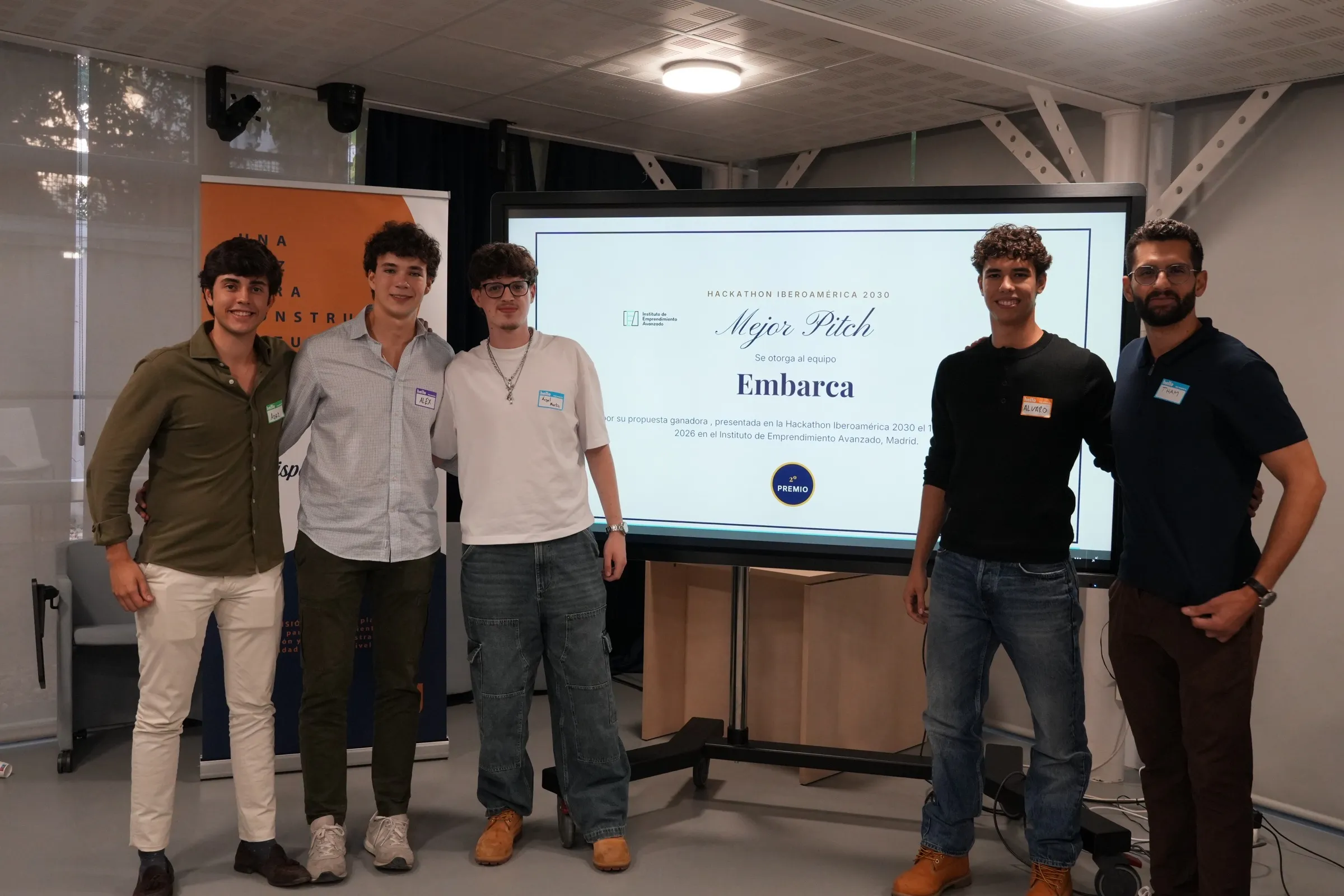
"If you don't win, you don't lose" is the idea we built Embarca on. It's also the best way I've found to explain why I keep signing up for hackathons.
This time it was the Iberoamérica 2030 hackathon by Club Hispanidad Futura, at the Instituto de Emprendimiento Avanzado in Madrid, just a week after winning another one. I did it with Álvaro Carpintero López, Alejandro Serrano Ruibal, Adrián Cervantes Menéndez and Thameur Triki. We built Embarca, a platform of real challenges from companies so young people can prove what they can do, came second and won the best pitch award.
First, what hackathons have that hooks me like this. Then, how the day went: what we cut, what we built, what broke along the way and how we got to the pitch.
What hackathons have
Time
I can't quite say what it is, but they're addictive. I've spent a few days trying to work out why, and I think the first reason is time. At a hackathon, everything that a normal project spreads over weeks happens in a few hours: understanding the problem, arguing about ideas, dropping half of them, building, watching it break, fixing it and defending it. There's no room to overthink anything. Every decision shows up straight away, for better or worse, and that forces you to think faster and more clearly than on any other day.
Solving problems
What I like most about a hackathon is that you're given a problem you don't know and a few hours to solve it. Nobody tells you how. You have to understand it, think of several solutions, drop the ones that don't fit in the time you have and keep the one that best answers the real problem.
In this one, the challenge wasn't even technical: it was how to give young talent opportunities across two countries. Before writing a line of code we had to decide exactly which problem we were going to solve, and that part, thinking up the solution, is the one that hooks me most and teaches me most.
The people
And then there are the people. At a hackathon you're surrounded by people with the same mindset as you: people who decided to spend the day building something instead of resting, and who do it with a huge amount of talent. You work side by side with your team, with mentors who tell you what you don't want to hear, and with a jury that has a few minutes to understand what you built in a whole day.
And the atmosphere is always great. Everyone is rushed and under pressure, but nobody loses the will to help, to ask or to show you what they're working on. Often what changes your project doesn't come from your own table, but from a mentor's question or an objection you know the jury will raise.
Even if you don't win
At a hackathon one team wins and the rest don't, and still nobody leaves empty-handed. You walk away with something that works and that you can show, a handful of decisions that would have taken weeks at a normal job, and a list of mistakes you won't make again. If you win, great; if not, all of that stays the same.
It's the same idea we built Embarca on: every attempt counts, even if it isn't the winning one. And it's what makes you start thinking about the next one as soon as one ends.
Embarca
The challenge
Every team had the same challenge: turn the Ibero-American community into a technology platform of opportunities for young talent. It had to be ready for a 90-day pilot between at least two countries, cover five dimensions (talent and education, technology and AI, funding, social impact and institutional relations) and end in a prototype "able to qualify real demand".
The jury scored mostly impact on young talent (25%), innovation and use of AI (20%) and the viability of the pilot (20%). The pitch was worth only 10%, which is funny given how it ended.
The organisers offered Lovable to put the prototype together quickly, a good option for a day like that. We chose to write the code from scratch, on Next.js, Supabase and Vercel, because we wanted to show something that could launch as it was when the day ended, not a mock-up. That raised the bar for us: everything in the demo had to work.
Cutting before building
The first line of code didn't land until after twelve. The morning was for deciding what to build and, above all, what not to.
The idea we started with was huge: challenges from companies and from the Club itself, a system to connect the best people with companies, a talent passport bringing together challenges, GitHub and LinkedIn, and even voice input through a chatbot. The mentors told us what we needed to hear: scalable, but far too big. We needed a niche.
They gave us three more pieces of advice. Set ourselves apart from platforms like HackerRank, which are there to filter people who are already job hunting; we wanted to give a first real experience to people who don't have one yet. Put ourselves in the shoes of every actor, one by one (the university, the company, the student, the competition and whoever would fund it), with what they want, what they fear and the trick questions they would ask. And, above all, go to the root cause of the problem.
So we cut. Out went voice, LinkedIn and automatic matching, which was really just sorting submissions by grade. We kept one profile, junior tech, two countries, Spain and Colombia, and one question we knew the jury would ask: "isn't this just free work?".
The answer to that question became the core of the product. The company grades every submission, not just the winner, and every grade stays in the student's passport. If you don't win, you don't lose: you walk away with proof of what you can do, signed by a real company. And when each challenge closes, the top three submissions are opened to every student so they can learn from them.
There was another decision we made early and never changed: the AI doesn't grade. It turns what the company describes into a challenge with a deliverable, a deadline and a rubric, and it summarises each submission so grading takes less time, but a person gives the grade. Assessing candidates with AI is a high-risk use under the EU AI Act, and that went from being a limitation to being an argument.
The real problem
The data drew a paradox. In Spain, 22.7% of under-25s are unemployed (Eurostat, August 2026), and in Colombia youth unemployment is 14.1% (DANE). At the same time, 78% of Spanish tech companies say they can't fill their vacancies (ManpowerGroup). There are young people looking for work and companies looking for people, and they don't meet.
To get to the cause, we did the five whys. Why don't companies hire young people? Because they ask for experience. Why do they ask for experience? Because hiring a junior is a risk. Why is it a risk? Because a degree and a CV don't say what you can do. Why is there no other way to know? Because the only credible proof is having worked with a real company, and those opportunities are few and go through contacts. And why are they few? Because setting them up takes time and coordination, and nobody takes on that cost.
That became the basis for everything else: there is no credible proof of what a young person can do, and getting it is expensive and scarce. Across countries it's even worse, because a degree doesn't travel. A grade from a real company does.
How we built it
Splitting up the work
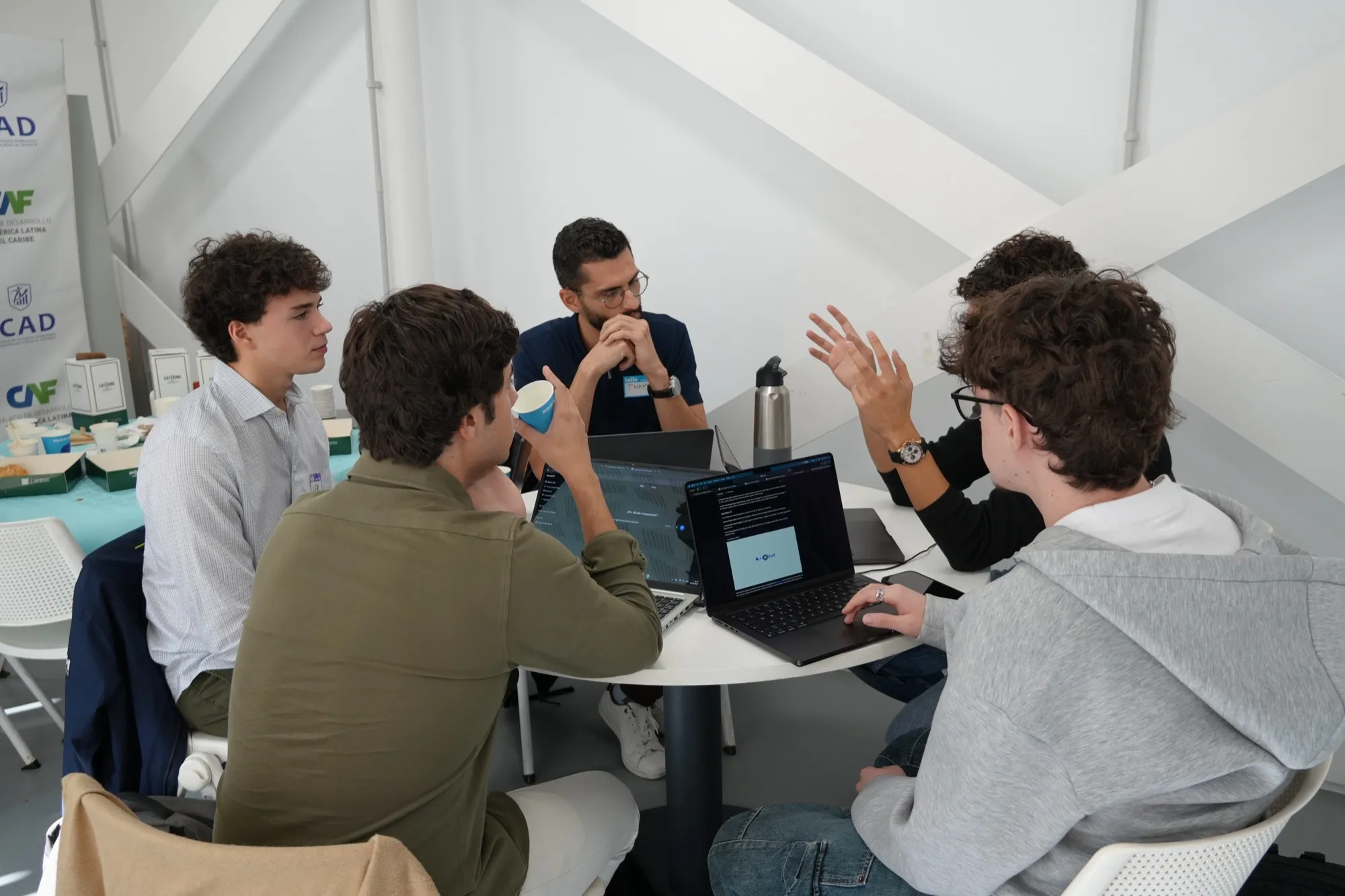
With five people and a few hours, the main thing was not to get in each other's way. Before writing any code we agreed who did what and how we would coordinate, and split the app into parts that could be built at the same time, without waiting on each other. Each of us worked with our own AI agents, and any change that touched someone else's part was asked for before it was made.
Saturday ended with 89 commits and sixteen screens.
Giving it shape
We shaped the idea together. My part was mainly the design: the UI, the UX and the visual identity of the whole app, and it was where we started from scratch the most times.
We began with the Club's brand: its crest, cream, navy and gold. We tried several typefaces and several names, and none of them quite fitted. The home page went through a dark tech version, three directions we designed and dropped, and an open passport with stamps falling as you scrolled. It all looked fine, but it looked too much like any other website made with AI.
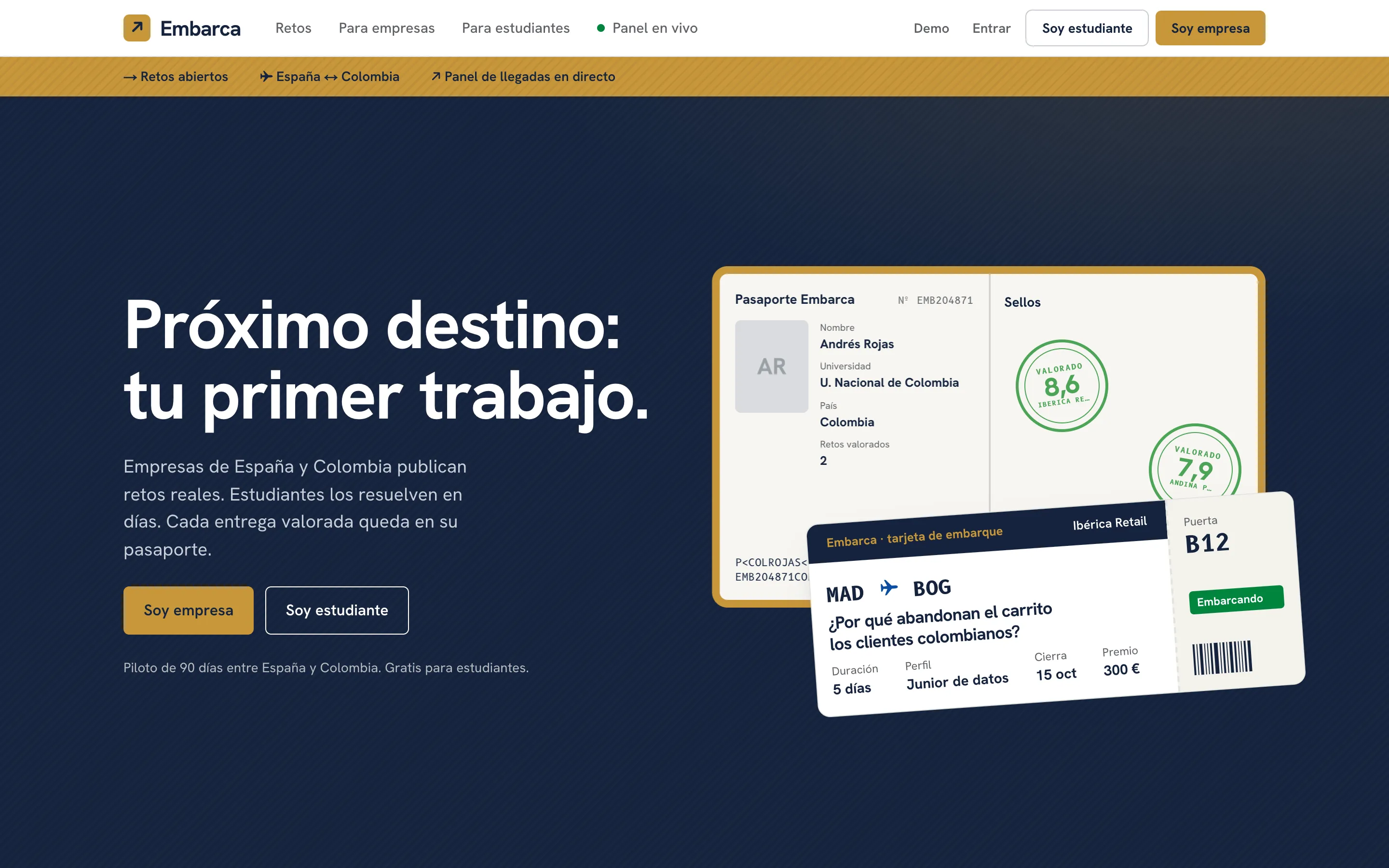
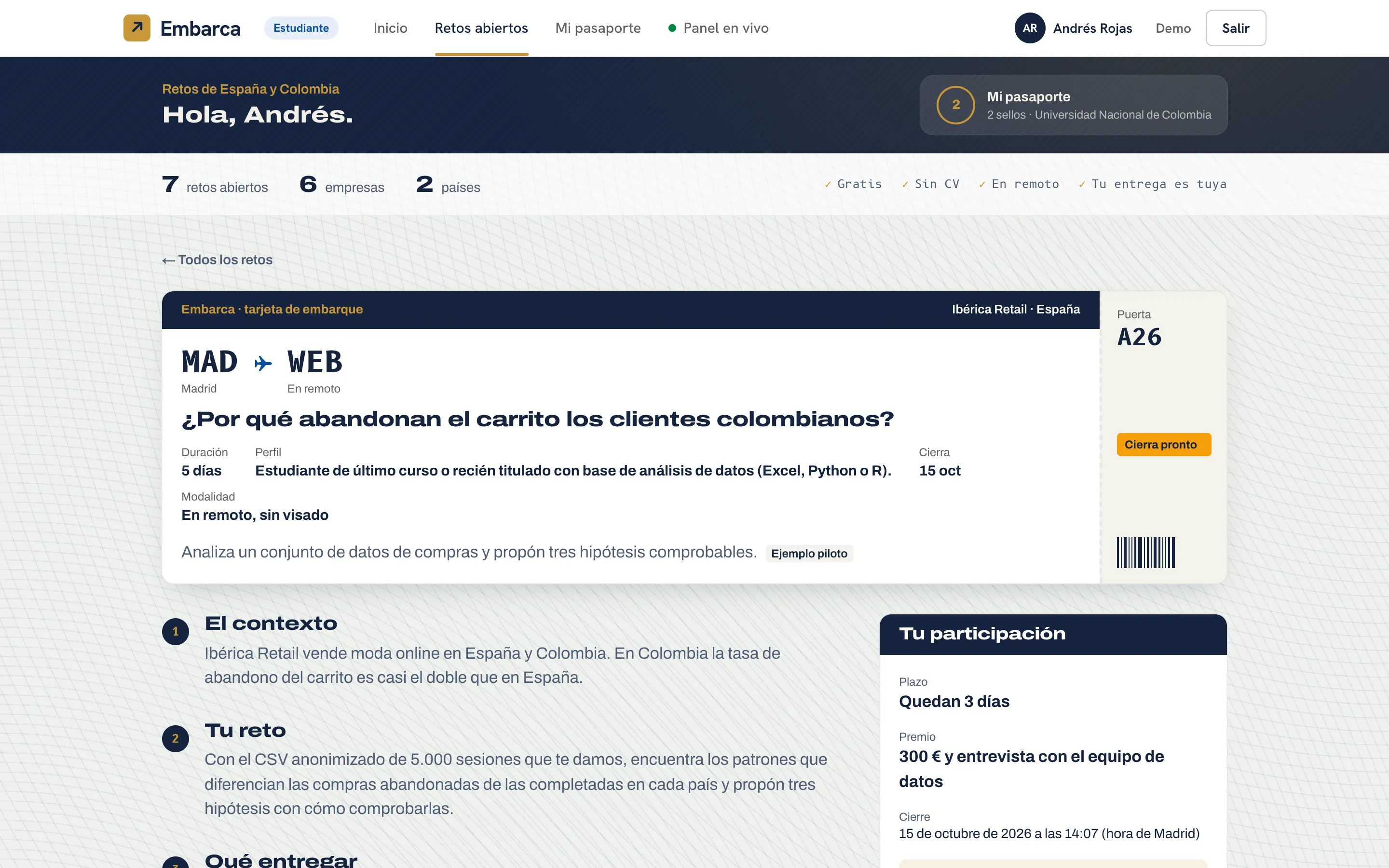
What unlocked it was taking the passport seriously. If the student is a passport, the company checking it is an airport and each challenge is a boarding pass, with its route, its gate and its status. From there everything fell into place: airport board colours for each challenge's status, colour-coded grades on the stamps, security-paper stripes on the backgrounds and real routes on every pass, like Madrid to Bogotá.
The name came with the idea: Embarca, Spanish for "board". And with it, the home page line, "Next destination: your first job", and the one that closed the pitch: "A degree says where you come from; a stamp, where you can go."
How it works
The student logs in and sees their upcoming departures: challenges from companies in Spain and Colombia, and from the Club itself, each one as a boarding pass with its route, duration, the profile it's looking for, closing date and prize. The ones about to close are shown separately. Opening one shows the context, the task, the deliverable and, before starting, the rubric they'll be graded with.
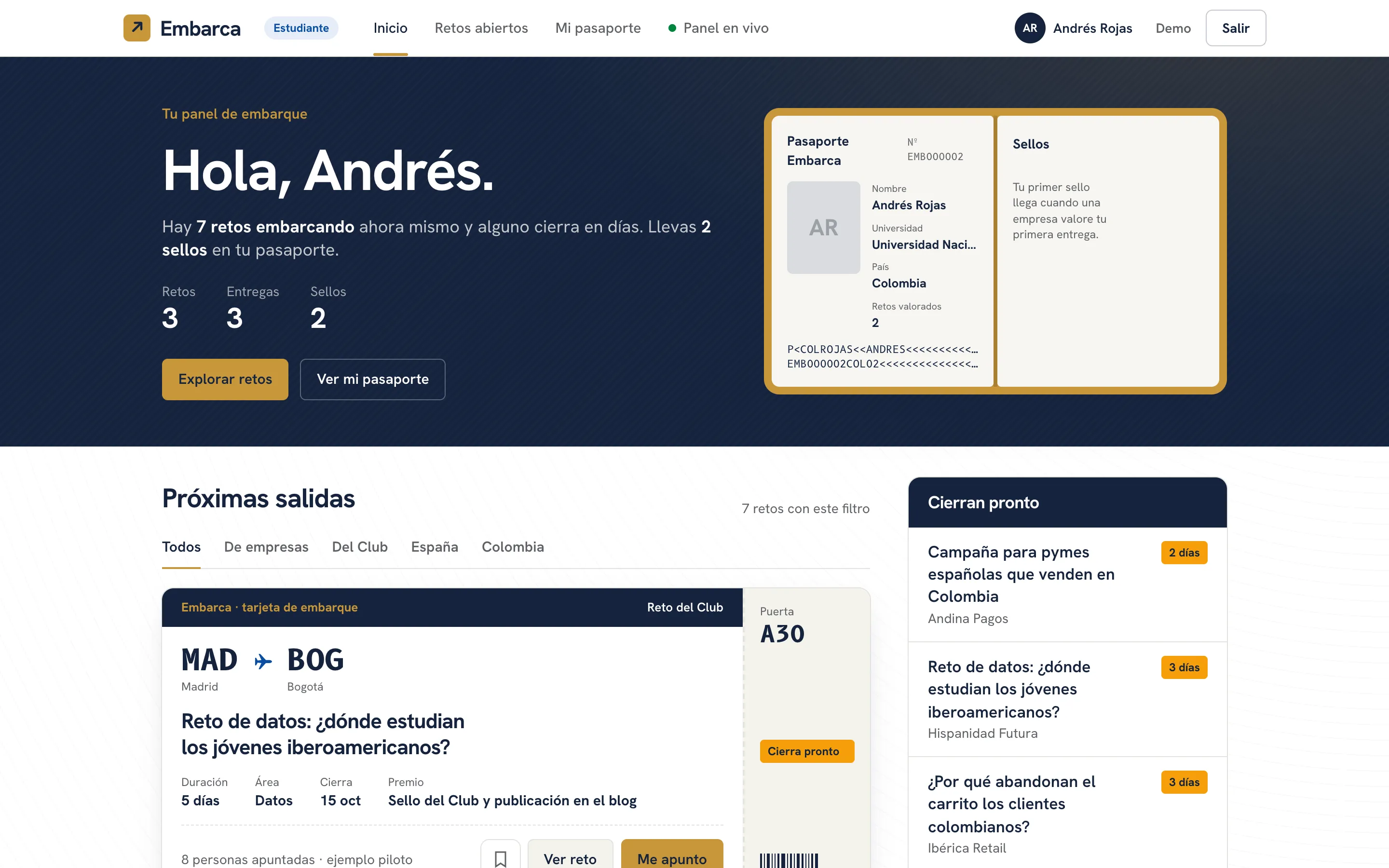
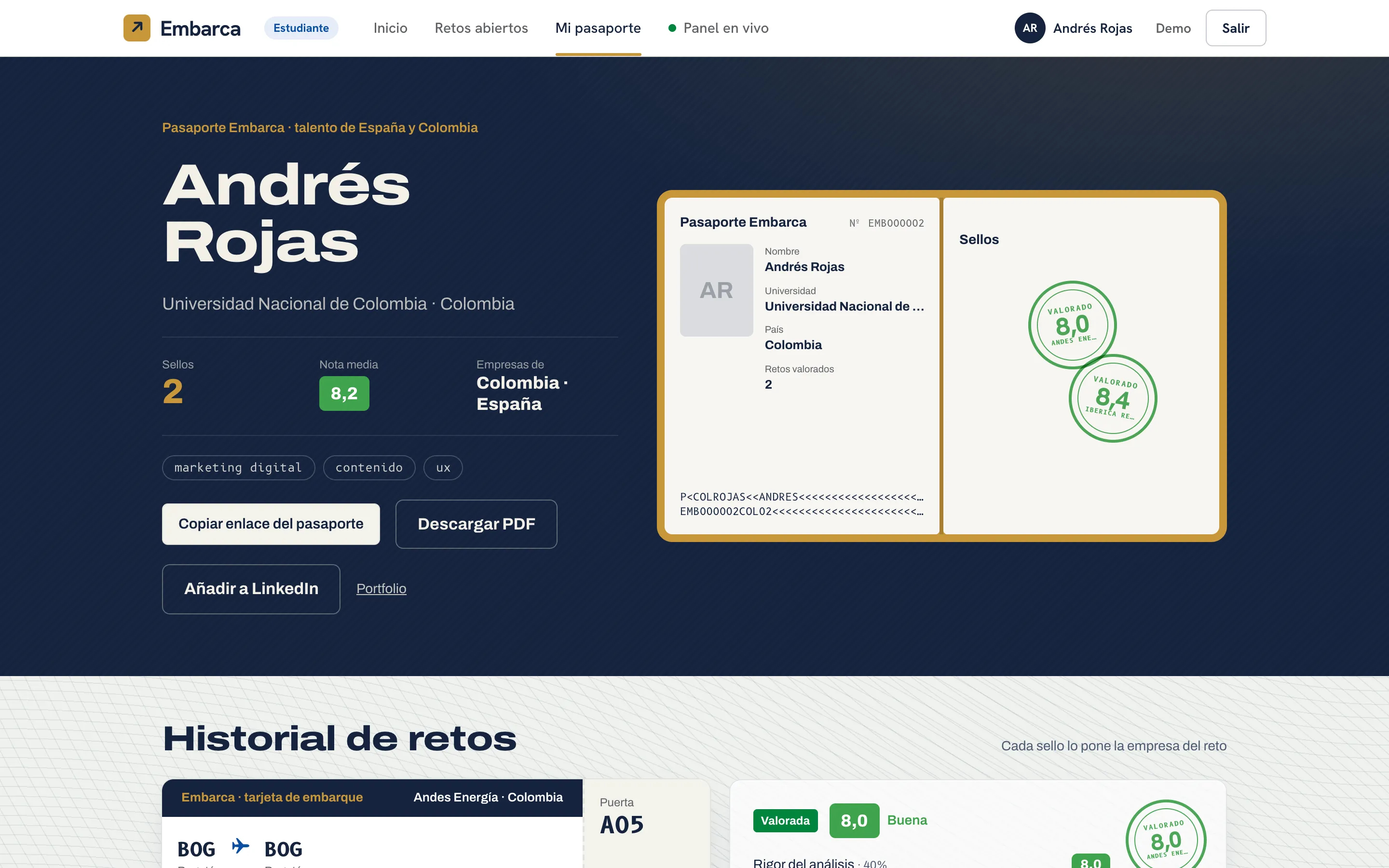
When the company grades their submission, the stamp appears in their passport with the grade, in a colour from green to red depending on the result. The passport has its own public page, meant for the student to share the way they would share a CV.
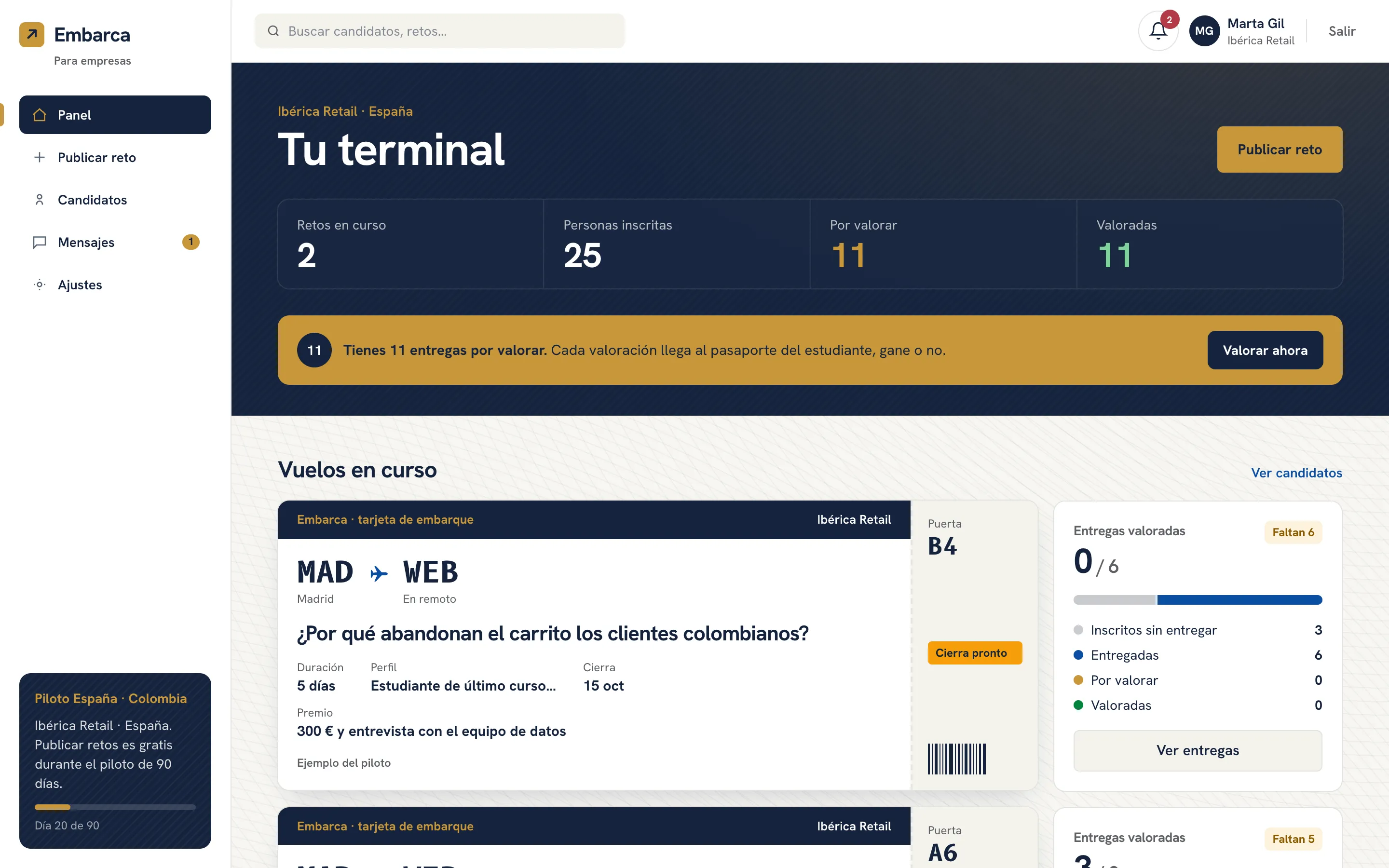
The company works on a different screen, its terminal. To publish a challenge it writes what it needs in its own words, and the AI prepares a draft with a title, task, deliverable, deadline and rubric, which the company reviews before publishing. From the terminal it sees each challenge as a flight in progress and how many submissions are still waiting for a grade. When grading, it scores each rubric criterion according to its weight; the final grade is calculated automatically, but every number is set by a person.
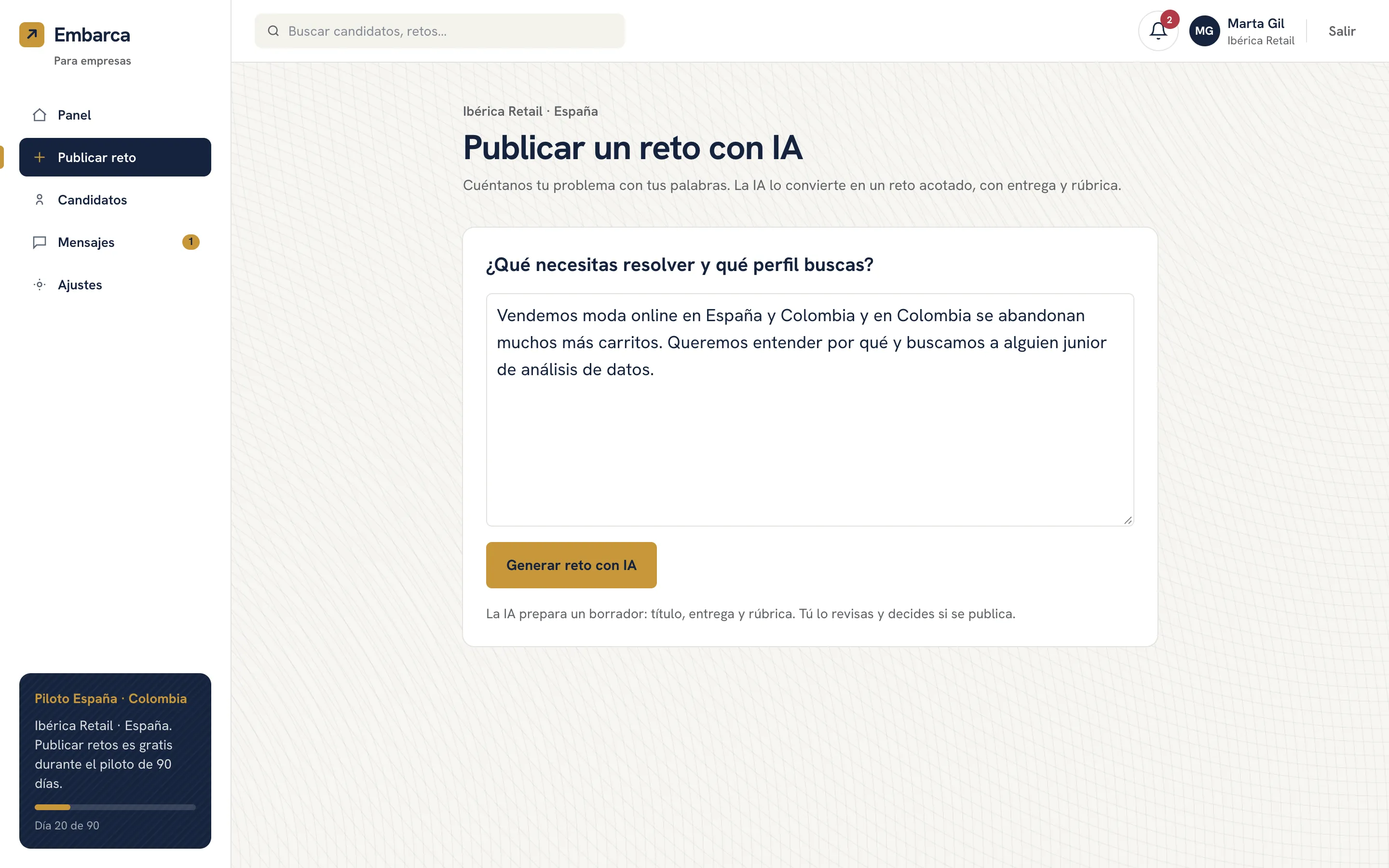
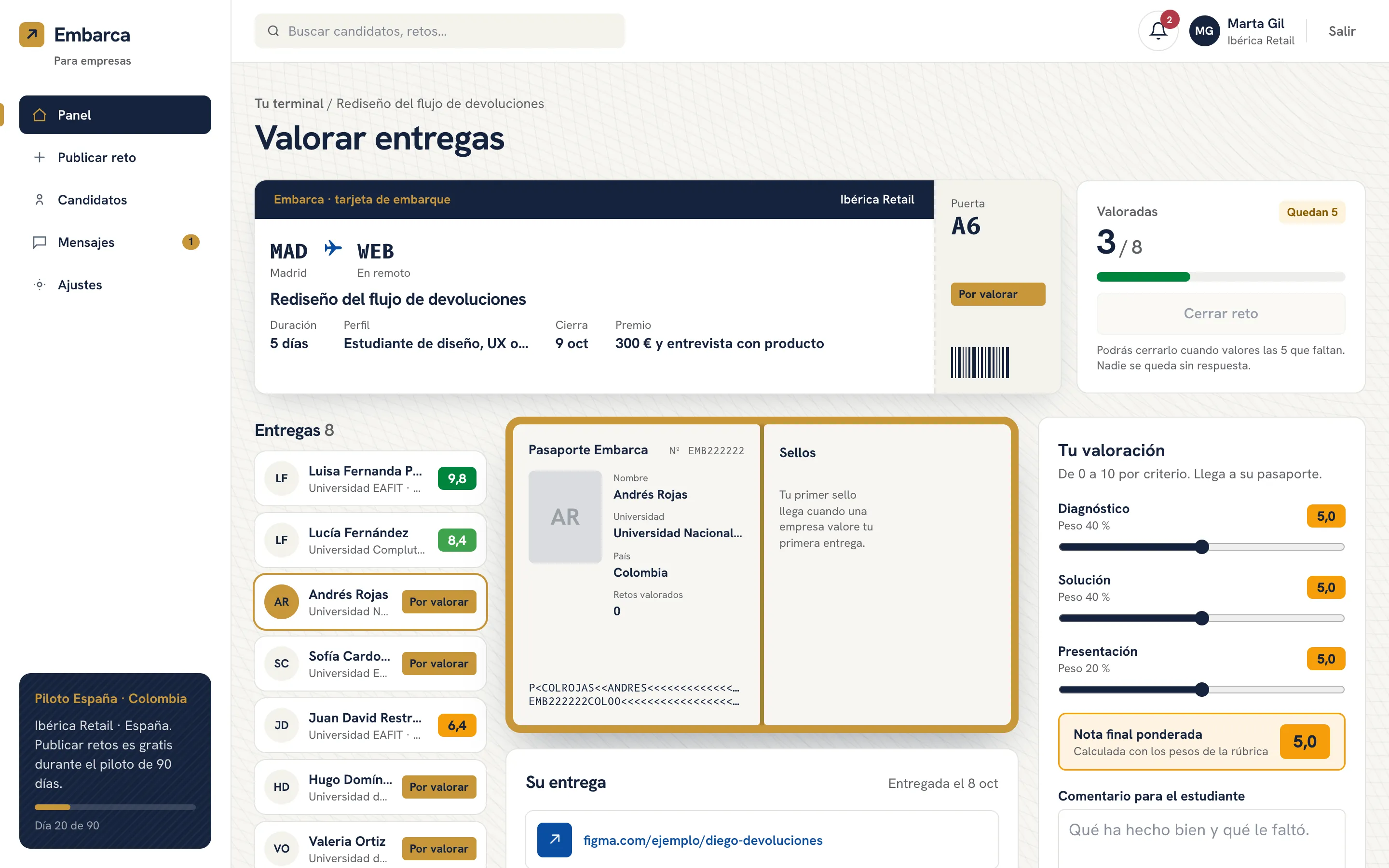
For the demo, the AI ran in simulated mode: it built the challenge from the company's real text without calling any model, so we didn't depend on the network live. The code that calls the model is written and turns on with a switch.
And the live board, designed like an airport arrivals board, shows who is signing up.
What broke
At a hackathon something always breaks, and almost always at the worst moment. It happened to us more than once: pieces that worked on their own and stopped working when we put them together, or details that only showed up when we used the app the way the jury would.
None of those bugs was hard to fix. The hard part was finding them in time. What saved us was testing the whole demo, end to end, instead of each screen on its own, and keeping some margin at the end to fix whatever came up.
There was one thing, though, that we chose not to touch: the live board, which shows who signs up, only counts real sign-ups, even when it reads zero. The challenge asked to qualify real demand, and an inflated number there would have said exactly the opposite.
Getting to the pitch
Who pays and how it starts
A product like this has two sides, and the challenge also asked for it to be sustainable. Students and universities never pay, and publishing a challenge is free. The company pays €250 for the contact of each person who solved its challenge, or €1,500 for a premium plan that gives it every contact from its challenge and features it above the rest. We don't charge a hiring fee because we can't check whether the company hires; we charge for something we can see.
But the hardest part of a marketplace like this isn't the price, it's the chicken and the egg: without challenges no students come, and without students no companies come. So the pilot starts the other way round. We prepare the first challenges ourselves, from junior job offers that are already published. Students arrive through their lecturers, at one university in Spain and one in Colombia. And companies come last, with the work already done: these students have already solved your job offer.
The plan runs for 90 days, starts at the Ibero-American Summit in November and is measured with four numbers the app already stores: between 60 and 100 sign-ups, at least 60% submitting, at least 90% of submissions graded and at least five contacts between companies and students. The one that matters most is the 90%, because without a grade there is no stamp.
The pitch
There were two pitches. The first, halfway through the day, was a practice run: we presented to the mentors and they gave us feedback to sharpen it before the real one. I gave that one.
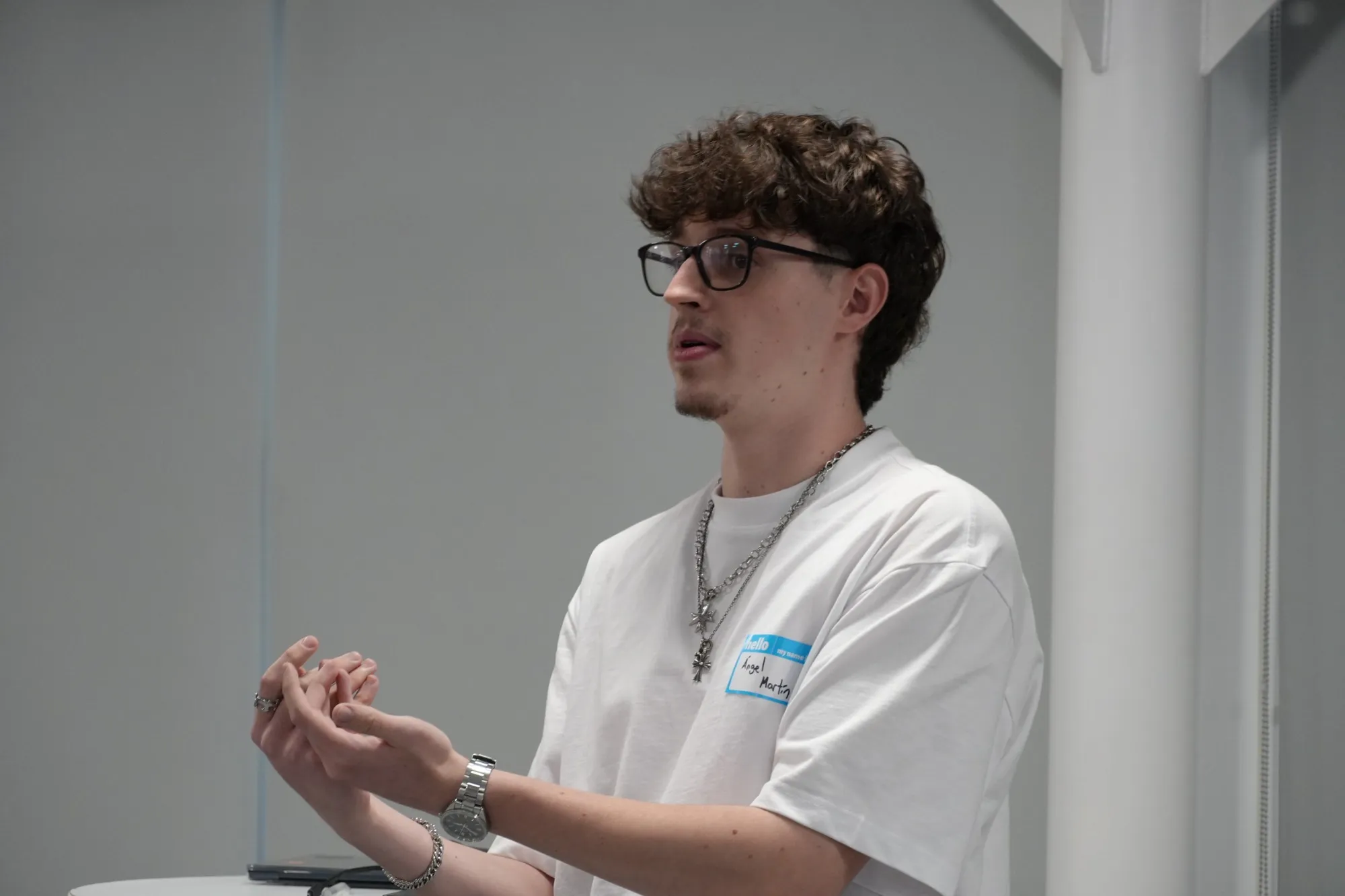
The real one came at the end of the day, and we all presented it together. We got there with the app deployed and the full loop tested: a company publishes a challenge, a student sees it, submits, the company grades it and the stamp appears in their passport. We built the deck during the afternoon, at the same time as the app, as an animated presentation with the same brand. It told the problem through Andrés, a sample student who has just graduated in Bogotá, then the solution, a 30-second demo, the idea that if you don't win you don't lose, the business model and the pilot with its targets. It ended with the stamp line and a QR code so anyone in the room could try the app right there.
The jury gave us second place and the best pitch award.
What I take with me
What I learned
We came second. We didn't win, but we didn't leave empty-handed either: we took home the best pitch award, a deployed app and a whole day of learning.
I take two things from the day. The first is cutting. We arrived with a five-part idea, and the part that survived was the one that answered the hardest objection. In a normal project that can take months to see; here we saw it before lunch. The second is that a day goes a very long way when everyone knows what they're doing and nobody has to wait for anybody.
And I think that's exactly what's addictive. You arrive with nothing and leave with something that works, that someone has put to the test, and that taught you more than many normal weeks. You get things wrong several times in a few hours, and each mistake is either fixed in time or ends up in the pitch. When it's over, all you want is to do it again.
And that's what I take most from Embarca, beyond the award. What we built for students, that every attempt is kept and counts even if it isn't the winning one, is exactly what hackathons give me. On Saturday we didn't win. But I got one more stamp.
Thanks
Thanks to the Club Hispanidad Futura organising team, Gemma Prieto Capell, María Victoria Felipe, Borja Vega and Anika Cámbara Valencia, for putting the hackathon together; to the Instituto de Emprendimiento Avanzado for hosting us, and to the mentors and the jury for their feedback.
The demo is open: https://club-hispanidad-futura.vercel.app